

VR experience could improve mealtimes for people with dementia
Approximately 411,000 Australians are estimated to be living with dementia, and that number is expected to reach 849,300 Australians by 2058.
![<p>With technology continuing to be developed, healthcare workers may also improve dementia care by engaging in this virtual reality experience. [Source: Shutterstock]</p>](https://agedcareguide-assets.imgix.net/news/articles/wp/vrnurse1208.jpg?fm=pjpg&format=auto&w=550&q=65)
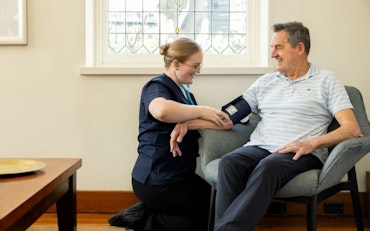
With technology continuing to be developed, healthcare workers may also improve dementia care by engaging in this virtual reality experience. [Source: Shutterstock]
Key points:
- Dementia Australia has developed a virtual reality experience called Dine with Ted to help healthcare workers improve the quality of mealtimes for people with dementia
- Approximately 411,000 Australians are estimated to be living with dementia, and that number is expected to reach 849,300 Australians by 2058
- Improving dining outcomes for people with dementia can involve eating in well-lit rooms, serving familiar foods and removing distractions
Dementia Australia has recently released a virtual reality experience to assist health workers in caring for patients with dementia at mealtimes.
The program, called Dine with Ted, allows participants to engage in a dining experience from the perspective of a person living with dementia.
The three-hour virtual reality program is delivered in person and aims to educate participants on several dining aspects that affect people with dementia, including:
- what it’s like to eat in an aged care home;
- how certain factors can impact the dining experience and how to improve these; and
- how to assist when eating behaviours change.
Approximately 411,000 Australians are estimated to be living with dementia, and that number is expected to reach 849,300 Australians by 2058.
While symptoms of dementia can vary depending on the cause and type, cognitive and psychological changes are common.
Some cognitive changes may include memory loss, confusion or difficulties with communication. Agitation, depression or inappropriate behaviour may be indicative of psychological changes as a result of dementia.
However, behavioural changes related to food can include forgetting to eat or drink, struggling to use cutlery, forgetting how to chew and swallow and experiencing a loss of appetite.
To make mealtimes easier for people with dementia, some suggestions from the Dementia Australia website include serving familiar foods, keeping the table free from distractions such as salt and pepper shakers, creating a calm and quiet environment and using no-spill cups.
Chief Executive Officer of Dementia Australia Professor Tanya Buchanan highlighted the value of aged care workers developing their understanding of food through the perspective of someone living with dementia.
“For people living with dementia in community, home or residential care, a positive dining experience is so important,” she said.
“Dine with Ted responds to the upcoming strengthened Aged Care Quality Standards around dining experiences for people living in aged care, as they have an elevated importance.”
Dine with Ted is suitable for healthcare workers including aged care workers, dietitians, registered nurses, allied health workers and speech pathologists.
Healthcare organisations can book in their staff to participate in the Dine with Ted experience on the Dementia Australia website.
Currently, healthcare workers can’t participate in Dine with Ted individually, but a range of other courses are available including the free Demonstrating Dementia Leadership course and the Quality Dementia Support in Hospitals course.
Rachel Mead, a manager at Regis Aged Care, stated that using virtual reality can expose healthcare workers to thinking differently about meals in aged care homes.
“The technology used can really transport people to capture different perspectives. It was eye-opening,” she said.
Other forms of training to educate healthcare workers include the Talk with Ted program, which involves an interactive avatar that presents with dementia symptoms. Participants can engage with Ted for a one-hour experience on their laptop or desktop computer.
Alternatively, a face-to-face option for groups is available, with registration available on the Dementia Australia website.
However, using other new technologies may also be more common when caring for older Australians in the near future.
The Australian College of Nursing recently released a statement regarding the use of artificial intelligence in Australian healthcare settings.
If AI is implemented in Australian healthcare settings, such as aged care homes, nurses could use AI to manage general administrative tasks, allowing nurses to use their knowledge in more urgent matters such as direct care.
Around 370,000 aged care workers in Australia are currently employed in direct and indirect roles. However, current estimates suggest that 212,000 full-time worker roles in the aged care industry will be vacant by 2050.
To learn more about AI and how it could impact aged care services, read this article: Australian nurses may soon be using artificial intelligence in healthcare settings.
What do you think about technology such as VR being used to train healthcare workers?
Let the team at Talking Aged Care know on social media.
For more information and news in the aged care industry, subscribe to our free newsletter.
Relevant content:
A 93-year-old cowboy shares wisdom and forms friendships with younger riders
Experts pose bold aged care strategy to help Australia’s outback
Aged Care Employee Day celebrates the efforts of over 370,000 Aussies