

Juniper student aims for aged care career
A recent partnership between a Western Australia aged care provider and Curtin University has inspired a nursing student from India to pursue a new career path in aged care.
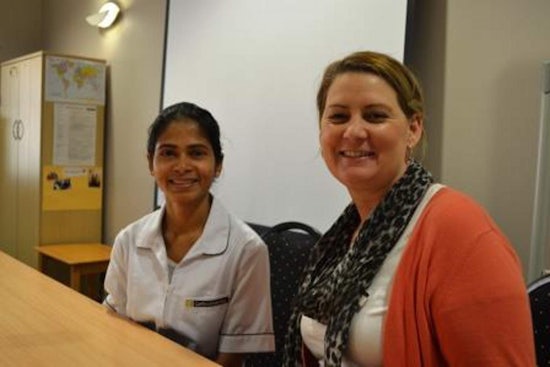
Priya Varghese (left), a nursing student from India, is undertaking a one year conversion program with Curtin University who partners with residential care facility Juniper Annesley.
Seeking registration as a nurse in Western Australia, Priya Varghese is undertaking a one year conversion program with Curtin University who partners with residential care facility Juniper Annesley, to provide an Interprofessional Practice Program (IPP) for health science students.
Ms Varghese previously worked in India as a child and maternal health nurse and had earlier this year undertaken a six week placement at Juniper Annesley, where she has been exposed to aged care for the first time.
“In my country we don’t have nursing homes because as people age, they are cared for by families until it becomes necessary to go to a hospital,” Ms Varghese says.
She says the supportive working environment at Juniper Annesley has given her the confidence to strive for a future in aged care.
“I have very much enjoyed the teamwork and understanding other areas of care such as physiotherapy and speech therapy. Juniper Annesley has been a great place to learn and everyone has been very supportive,” she says. “Once my registration comes through I will definitely be applying for a job in aged care,” she adds.
Juniper Annesley’s learning and innovations coordinator, Jo-Anne Coughlan, says it's wonderful to see the students strive for a career in aged care following their placements.
“Ms Varghese is a wonderful nurse and has embraced the transition into the aged care environment really well. She is very knowledgeable, thorough and compassionate and I see her making a significant contribution to the aged care industry,” Ms Coughlan says.
Since the IPP program commenced in 2013 more than 200 students studying nursing, occupational therapy, speech pathology, counselling and pharmacology have completed a placement at Juniper Annesley.
The program sits under Juniper’s Teaching Residential Aged Care Service (TRACS), a broader partnership with Curtin University that is establishing Juniper Annesley as a centre of excellence for aged care and the premier site for best practice clinical placements for health science students.
Denise Griffiths, interprofessional practice facilitator at Curtin University, (pictured with Ms Varghese), says the IPP focuses on a multidisciplinary team approach to aged care where people are often experiencing multiple health conditions.
“Some of the benefits we are now seeing from interprofessional practice include an enhanced understanding of other health professions, more appropriate referrals, greater staff satisfaction and therefore better results for residents,” Ms Griffiths says.