Taking retirement living to a higher level
Six floors of retirement living residences, office and retail space, long-term rental accommodation for people living with a disability and a 400 seater function centre are just some of the functions of a 20-storey, multi-use development being planned by a South Australian provider.

Uniting Communities Chief Executive Simon Schrapel
The $80 million pioneering redevelopment of Uniting Communities’ headquarters in Adelaide’s CBD will not only give older people and people with a disability the opportunity to live and enjoy the heart of the city, but it aims to create a genuine interactive community between all users of the building.
Uniting Communities Chief Executive Simon Schrapel says there has been lots of discussion about what people want in the future and he highlights baby boomers will have different seniors’ expectations.
“Current care is not attractive to this ageing population – we are working longer, are more active and have more technology,” he says, highlighting the move to support people in their own home.
He believes baby boomers will demand personal independence, social enjoyment, a home-like environment and will want continued community interactions.
The number of Australians over the age of 65 living in retirement living options is currently just under 6 per cent, and this is predicted to rise to 7.5 per cent in 2025. “In South Australia we’re already at 8 per cent,” says Mr Schrapel.
However he feels the villages are of the old mentality, which he describes as ‘old people are better together and we’ll herd them into a community’. Mr Schrapel believes the new building will see a move from dysfunctional segregation to functional integration.
“This is a more normative situation, where there is interaction with people across the generations,” he says. “This building will be where people live, work, dine and shop.”
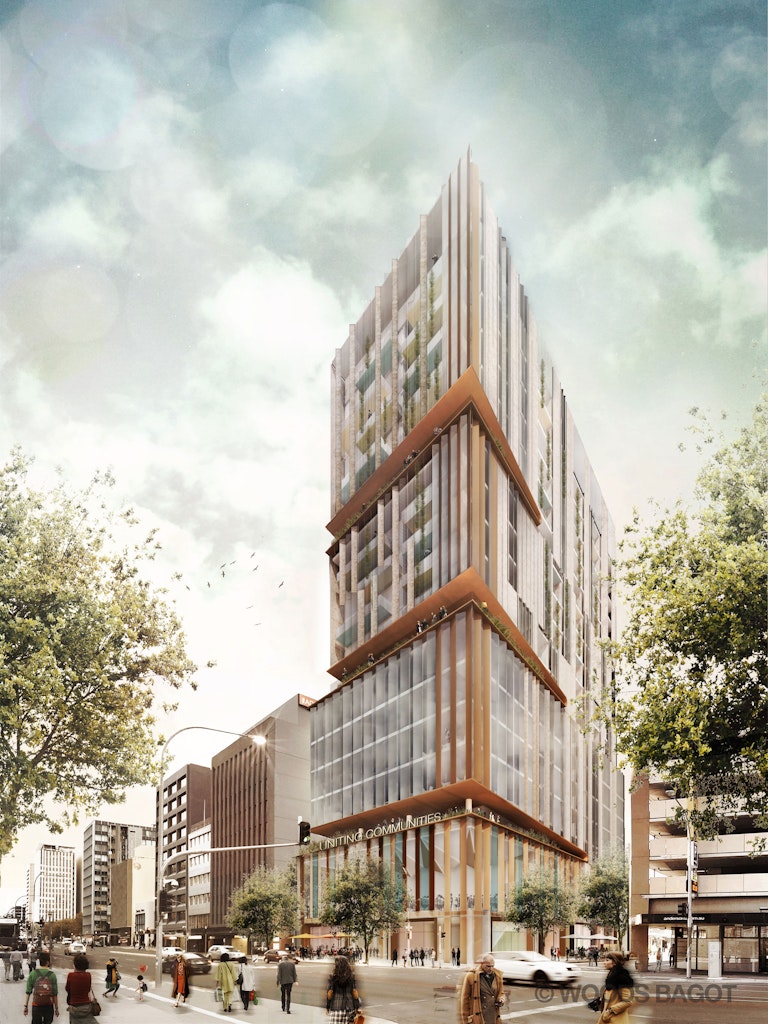
Mr Schrapel claims Uniting Communities ‘UCity’ will be different from
other multi-use buildings seen elsewhere in the world as it provides
more opportunity to interact with other functions of the building.
These include been home to a wide range of Uniting Communities
services and activities such as voluntary opportunities and physio
classes. Plus it will be inviting people from outside the community too,
with its ground floor café, retail centre and function centre.
“All of this and slap bang in the city, next to the Central Markets, Her Majesty’s Theatre and the Oval,” he says.
The design of the building is also encouraging integration with ‘bunk
points’ for people to meet; although there have been some challenges,
such as ensuring the core for stairs didn’t go through the centre of the
conference room!
In keeping with Uniting Communities environmentally philosophies,
Uniting Community is the first charity to be carbon neutral, the
building will include provision for storage of PVC power points to
charge electric vehicles and other environmentally friendly
initiatives.
The development is expected to be completed in 2018. To learn more, visit the Uniting in the City website
Mr Schrapel is speaking about the new Uniting Communities project at
the Criterion Conference ‘Driving Growth in Retirement Living’ in
Melbourne later this month.
The conference will gather key stakeholders and case studies from
across the retirement sector to discuss key practical information on the
pressing concerns of the retirement industry.









![The new Aged Care Act exposure draft is slated for release in December of 2023, but advocates hope to see it rolled out on January 1, 2024. [Source: Shutterstock]](https://agedcareguide-assets.imgix.net/news/articles/wp/agedcareact__0811.jpg?fm=pjpg&w=520&format=auto&q=65)









Comments