
What makes us ‘senior’?
New research released by Bethanie, a West Australian not for profit aged care service provider, reveals the state has conflicting opinions on what makes a person a ‘senior’.
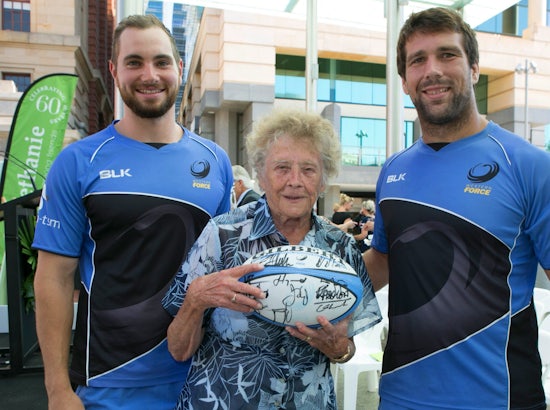
Chris Alcock and Louis Dallimore present a signed WF ball to Bethanie sports fanatic, Joan Greer.
The poll asked more than 500 people, aged from 16 to over 70 years what age they consider to be ‘senior’, and found one in 10 people aged under 35 years think becoming a 'senior' happens between the ages of 50 and 55 years, whereas a third agree it's when we hit the '60' mark.
Comparatively, one in five over 55s firmly believe they won't become 'senior' until their 70th birthday, with a 10th of over 70s refusing to admit senior status until 75 or over.
The results have been released to coincide with Bethanie’s 60th anniversary. To mark the occasion, Bethanie recently held an event this week in Forrest Place, Perth, which was officially launched by the Honourable Lord Mayor, Lisa Scaffidi.

Pop up tents in Forrest Place housed information on Bethanie services, free balance assessments, a Nintendo Wii and other senior specific information including that from Diabetes WA and COTA.
Guest speaker Louis Dallimore, strength and conditioning coach for RugbyWA and the Western Force, spoke on the importance of remaining healthy and active through all life stages, and even challenged player Chris Alcock to join in the Prime Movers’ over 50s exercise demonstration to see how he “shaped up”.
Mr Dallimore claims keeping healthy and active is as important for an athlete’s performance now as it is when they retire from the game, and even later on in their senior years.
“A recent study has found 150 minutes of vigorous physical activity each week can add two to three years to men’s lives. This is significant and something that should be on our radar from a young age so we can protect our bodies and our brains as we get older. Adding a few simple exercise techniques to our daily routines could be all it takes,” he says.
During the official Bethanie anniversary event, 60 balloons were released, each carrying a message from Bethanie residents on what they hope for the community, Western Australia or the world in the next 60 years.
Messages included one from 88 year old, Merle Robinson, who hoped for “total peace”, while 84 year old, Kathleen Salathiel’s wish was to “still be here in another 60 years to see all of the changes”.
Christopher How, Bethanie’s acting chief executive, claims with an ageing population, “trusted aged care services are becoming even more crucial”.
“The poll reflects what we’ve always known, but we’ve got some active 85 year olds who still believe they’re young. It depends where a person is at in their life,” Mr How says.
By 2042 in fact, a quarter of the population will be 65 years or older, so, according to Mr How, it’s important for providers to fully encapsulate a warm, open and active environment for seniors and the elderly.
“The main takeaway message is that the future is going to be about customer centric services and quality services. These are the two key elements which will either ‘make’ or ‘break’ providers,” he says.