

Encouraging older Australians to connect this festive season – PART TWO
In part one of Encouraging older Australians to connect this festive season, we looked at the importance and benefits of social connection as we age. Part two looks at ways to connect with others as well as how technology can play a part in reducing loneliness and isolation.
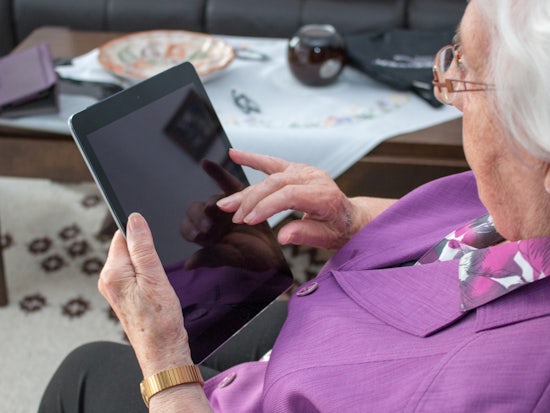
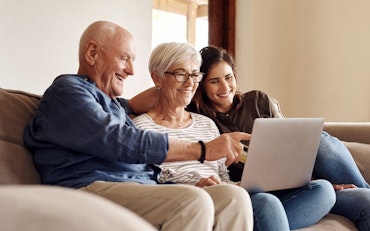
While not a replacement for face-to-face contact, technology can assist older people to stay socially connected and engaged. (Source: Shutterstock)
National Ageing Research Institute Director of Clinical Gerontology Dr Frances Batchelor says connecting with people who have similar interests is one way to remain engaged.
“Ideas for staying socially connected in the community include volunteering, joining a book club, joining an exercise group, learning something new or getting involved in men’s sheds,” she says.
Taking a walk down memory lane and reigniting old favourite activities can help seniors connect with others and get involved with their community, adds Dr Freak-Poli.
“People can start by writing a list of activities they enjoy or enjoyed in the past. Some of the activities may not be viable now, such as horse riding, but perhaps related activities, such as visiting and grooming a horse, may be possible,” she says.
“The list can be helpful in providing a way of communicating to family and friends what they could assist with. It is important to address what the barriers are for participating in these activities. Simply setting goals will not work without addressing the barriers. For example, is it simply transport to the location?”
Ms Brockett recommends checking community notice boards for activities, taking up a new hobby, or simply saying ‘hi’ to neighbours.
“New experiences through new social connections, particularly as we age, can sometimes test our confidence initially, in the search to enhance our lives,” she says.
“National Seniors is a great place to start – they have the interests of seniors wellbeing at heart both socially and politically. Join a bookclub, or maybe study through University of the Third Age, where you will find like-minded people. Or join a choir – it doesn’t matter if you think you can’t sing. It is so uplifting and so physically good for our bodies, lungs, mind and spirit to sing out loud.”
“Look for ways to be kind to your neighbours without overwhelming them, sometimes a smile and a bit of ‘a listen’ can be the beginning of a lovely friendship.”
Mr Piggott says he purposely seeks out roles that see him engage with others.
“These include leadership roles that provide the opportunity to chair meetings and address large audiences,” she says. “I have a fairly large circle of friends with whom I endeavour to maintain regular contact.”
National Seniors research shows that improving the digital literacy of older people, especially those from culturally and linguistically diverse backgrounds, keeps them engaged with the community and prevents them from becoming isolated.
Figures reveal there is more of a digital divide between younger and older seniors, rather than young and older age groups, with those over 80 feeling largely left out of the digital society.
Dr Batchelor says older adults are using technology in increasing numbers, particularly social media such as Facebook.
“While some people assume that older people are not able to use technology well, our research has shown that, with the right training and support, older people can embrace technology including using iPads, experiencing virtual reality and using technology to communicate with family and friends who may be in different cities or parts of the world,” she says.
“While not a replacement for face-to-face contact, technology can assist older people to stay socially connected and engaged.”
For Ms Brockett, technology plays a pivotal part in staying connected with others.
“I often text and message my family and friends. I play a simple word game by text with one old friend who lives alone every morning to make sure she is up and about,” she says.
Still preferring to have a conversation over the phone rather than Skype or Facetime,
Ms Brockett says she is still happy to use other forms of digital communication.
“Emails replace the old long letters we used to send and electronic greeting cards can be a pleasant surprise,” she says. “I do use Facebook Messenger to connect easily with a family member who doesn’t text.”
While he recognises the concerns older people have with advances in modern communication technology, such as potential scamming, unwanted callers and invasions of privacy, Mr Piggott says digital platforms play an important role in connecting
“I appreciate the need for people to remain socially connected, and the digital world may well be the answer in fulfilling the needs of those who are either unsure or unwilling to seek the companionship of people within their community.”
In an effort to reach older Australians who are yet to embrace the benefits technology has to offer, the Australian Government recently launched its Be Connected initiative, which encourages seniors to learn new skills from home or nearby community organisations.
Aiming to benefit more than 100,000 older Australians each year, Be Connected features free online training courses on a range of topics from computer basics, to online safety and how to make video calls, and links users to a national network of over 1,200 providers, including National Seniors, who provide free face-to-face training.
To access the Be Connected learning program from home, click here and fill out your details.
This article was written in collaboration with National Seniors Australia. With the collective voice of over 130,000 members, National Seniors Australia actively lobbies with government and business at all levels to get a better deal for older Australians. Make your voice count. nationalseniors.com.au